
Chełmno: What to Do With What You Have Seen?
is around 30 years old. Born in Izbica Kujawska, near Koło, he was rounded up with other Jews from the region and brought to a requisitioned manor in the village of Chełmno (Kulmhof in German), on the Ner river. There the Germans held back a handful of men to form a Sonderkommando: a unit of Jewish prisoners forced, under the constant threat of the SS, to carry out the physical labour of the killing.
On this 8 December 1941, the first convoys arrive. The deportees are promised resettlement to the east and a bath; they are made to climb into large lorries whose sealed cargo box is airtight. The exhaust fumes are diverted inside. When the doors reopen, in the Rzuchów forest, it is the Sonderkommando that must unload the bodies, search the mouths, dig the pits, and cover them over. Winer understands that he is witnessing the first extermination centre using gas vans, and that the men of his commando are themselves doomed to be killed so that no witness remains.
He grasps what no report has yet described. He can try to flee at the first lapse in the guard, to carry the account to the outside at the risk of being shot on the spot; hold on day after day without drawing attention, in the faint hope of lasting; or refuse to obey, sabotage the work, raise a hand against a guard — an act that means immediate death.
Chełmno, December 1941, a forced grave-digger in a Jewish commando: what should be done with what he is forced to witness?
escaped by slipping out of a lorry on 19 January 1942 and reached the Warsaw Ghetto. There he dictated to 's clandestine archivists, the network, a detailed account of the killing process: "The Account of a Forced Grave Digger." Circulated by the Polish underground in a reworked form to protect its author, the text became known as the Grojanowski Report — one of the very first first-hand descriptions of mass murder by gas. Winer was recaptured a few months later and killed at Bełżec. Chełmno, the first of the Nazi extermination centres and the prototype for Bełżec, Sobibór, and Treblinka, claimed at least 152,000 Jewish victims and several thousand Roma, deported above all from the Łódź ghetto and its surroundings.
Learn more about this event
Related polls
10
Jedwabne, 10 July 1941
AB Aktion — planning at the Wawel
Forster — Kashubians and Kociewiacy
Greiser — the Priority of the Wartheland
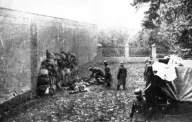
The Warsaw Ghetto — the ration of hunger
The Ninth Fort, Kaunas, October 1941
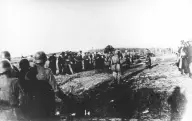
The Reprisal Quota at Kragujevac
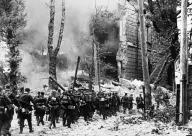
The Captives of the Ukrainian Pockets
Łódź — the Order to Seal Off the Jewish Quarter
Piotrkow — Tenenberg Facing the Judenrat
Jedwabne, 10 July 1941
AB Aktion — planning at the Wawel
Forster — Kashubians and Kociewiacy
Greiser — the Priority of the Wartheland
The Warsaw Ghetto — the ration of hunger
The Ninth Fort, Kaunas, October 1941
The Reprisal Quota at Kragujevac
The Captives of the Ukrainian Pockets
Łódź — the Order to Seal Off the Jewish Quarter
Piotrkow — Tenenberg Facing the Judenrat
T10-063