
After Kristallnacht of November 1938, British charitable organisations obtain from the government authorisation to take in Jewish children refugees from the Reich, without their parents and under financial surety. This is the Kindertransport: from December 1938 to the summer of 1939, convoys take toward the United Kingdom thousands of children from Germany, Austria and Czechoslovakia.
For the Jewish families caught in the trap of the persecutions and the wall of visas, these convoys open a narrow — but terrible — door. The parents, most often, cannot follow: only the children leave.
You are Berlin parents. Should you entrust your child to a convoy bound for a foreign country, among strangers, in the hope of saving them, accepting a separation that no one knows will be provisional? Keep the family together at all costs, betting on a common emigration still possible? Or defer, the time to gather the papers to leave all together, at the risk that the doors close? Each passing day narrows the field of the possible.
Berlin, June 1939, you are Jewish parents: should you bring yourself to send your child alone to England?
Historically, about 10,000 children were saved by the Kindertransports before the war interrupted the convoys in September 1939 — most families having made the heartrending choice of A. Many of these children will never see their parents again, who remained trapped and, for a number of them, were murdered during the Shoah. The Kindertransports figure among the rare large-scale rescue operations of the pre-war period; they will have concerned only a fraction of the threatened children, for want of countries willing to open their borders to the adults. The rescue of children remained the exception, not the rule. After the war, many of these children grown to adulthood will testify to this founding wrench and the loss of their kin.
Learn more about this event
Related polls
10
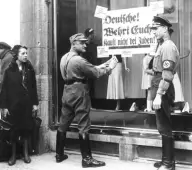
Flee or Stay
A Danzig Customs Officer on the Day of Annexation

Join the Party?
The Youth of the Reich
The Warsaw Ghetto — the ration of hunger
A Correspondent in Berlin
The Obersalzberg Speech
Hitler at the Reichstag: how harsh an antisemitic tone?
The German Student Facing the Nazification of the University (1939)
The Prague Notary and the Aryanization of Jewish Property
Flee or Stay
A Danzig Customs Officer on the Day of Annexation
Join the Party?
The Youth of the Reich
The Warsaw Ghetto — the ration of hunger
A Correspondent in Berlin
The Obersalzberg Speech
Hitler at the Reichstag: how harsh an antisemitic tone?
The German Student Facing the Nazification of the University (1939)
The Prague Notary and the Aryanization of Jewish Property
T00-018