
Badung Strait: Striking the Bali Convoy
commands the slender Allied squadron of ABDA, the American-British-Dutch-Australian command tasked with defending the Dutch East Indies. A meticulous Royal Netherlands Navy officer, he knows that the fall of would hand the Japanese an airfield within reach of Java, the last lock on the archipelago.
On 18 February 1942, a small Japanese invasion convoy lands its troops on , escorted by a handful of destroyers. Doorman is ordered to attack at once, but his ships are scattered across several anchorages and the warning is too short to gather them. Dutch and American cruisers and destroyers will therefore set out in separate groups, hours apart, into the narrow channel of Badung Strait. The Japanese crews, for their part, excel at night fighting and carry torpedoes of formidable range.
Doorman must decide how to strike the blow. He can launch the attack at once, in echelons, as each group reaches the area; wait until the whole squadron is assembled to strike in mass as a single body; or call off the engagement and preserve his ships for the looming decisive battle of Java.
Badung Strait, February 1942, the Dutch rear admiral commanding the ABDA squadron: how should the Japanese convoy landed at Bali be attacked?
went into battle in successive waves on the night of 19/20 February 1942. The first wave, built around the cruisers and Java, opened fire then withdrew; a second wave, led by the cruiser , arrived hours later and resumed the duel. For lack of coordination, the attack remained disjointed and each group faced the Japanese destroyers alone. A torpedo sank the Dutch destroyer ; the and the American destroyer Stewart were seriously damaged, while not a single enemy transport was lost. Despite being outnumbered, the Japanese protected their convoy, secured and captured Denpasar airfield intact. The action confirmed Japanese superiority in night fighting and foreshadowed the disaster of the Java Sea, where Doorman would die a week later.
Learn more about this event
Related polls
10
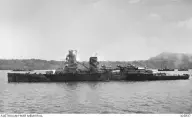
Java Sea — Doorman and the ABDA Squadron
The Last Stand of Perth and Houston
Ambon: Gull Force Driven to the Sea
Koh Chang — the Franco-Thai War
The Fire Night at Balikpapan
The Altmark affair
Boulogne — Fox-Pitt and the Guards facing the port
Campioni faces Cunningham off Calabria
Cape Matapan — Cunningham against Iachino
An unescorted convoy in the grey morning
Java Sea — Doorman and the ABDA Squadron
The Last Stand of Perth and Houston
Ambon: Gull Force Driven to the Sea
Koh Chang — the Franco-Thai War
The Fire Night at Balikpapan
The Altmark affair
Boulogne — Fox-Pitt and the Guards facing the port
Campioni faces Cunningham off Calabria
Cape Matapan — Cunningham against Iachino
An unescorted convoy in the grey morning
T10-078