
Toropets: How Far to Push the Breakthrough in the Snow?
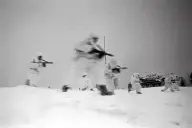
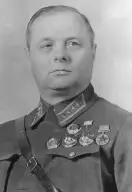
has commanded the for only a few days, barely out of hospital, at the head of a formation short of nearly 1,000 officers and 20,000 men. South of Lake Ilmen, on the North-Western Front led by , his army and 's 3rd Shock Army strike out on this 9 January 1942 against the flank of the German armies, across terrain of forests, frozen marshes, and deep snow.
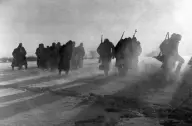
The breakthrough succeeds beyond expectation. The Soviet columns crush defences held by isolated strongpoints, capture Andreapol and then, on 21 January, the logistics hub of , about a hundred kilometres behind enemy lines, with vast supply depots. Each day of marching draws the infantry farther from its own bases: the sledges struggle to keep up, fuel and shells arrive in a trickle, and the winter cold bites men and horses alike.
Yeryomenko must decide on the exploitation: push hard to the south-west toward Velizh and Demidov, at the risk of dangerously stretching already taut supply lines; turn aside to reduce the German pocket forming around Kholm; or halt to consolidate the flanks and wait for logistics to catch up with the advanced spearhead.
North-Western Front, January 1942, the general commanding the 4th Shock Army: how far should a deep breakthrough in the snow be pushed on the German flank?
Yeryomenko pushed the breakthrough in depth: the advanced 100 to 250 km to the south-west, reached the approaches of Velizh and Demidov, and cut German rear areas. Wounded in the leg on 20 January 1942 when German aircraft bombed his command post, he refused to be evacuated until the battle was settled. Together with Purkayev's 3rd Shock Army, the offensive helped isolate the garrisons of Kholm and begin the encirclement of Demyansk. But the supply lines, stretched over hundreds of kilometres through the snow, ultimately curbed the momentum: Velizh remained in German hands, the offensive ran out of steam in the spring, and the front froze on the positions reached.
Learn more about this event
Related polls
10
Konev and the Rzhev Salient
How far to press the advantage?
Crimea, December 1941: the Soviet amphibious gamble
Snow Before Moscow — Zhukov and the Counter-Offensive
Volkhov Front: The Thrust Toward Lyuban
Rommel's Forbidden Gamble in Cyrenaica
Foreign Tanks in the Moscow Snow
Crimea, December 1941: Manstein's dilemma
Crusader: The Generals' Doubt
Guderian before Tula, October 1941
Konev and the Rzhev Salient
How far to press the advantage?
Crimea, December 1941: the Soviet amphibious gamble
Snow Before Moscow — Zhukov and the Counter-Offensive
Volkhov Front: The Thrust Toward Lyuban
Rommel's Forbidden Gamble in Cyrenaica
Foreign Tanks in the Moscow Snow
Crimea, December 1941: Manstein's dilemma
Crusader: The Generals' Doubt
Guderian before Tula, October 1941
T10-088