The Bomb or the Laboratory
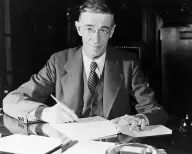
receives in early 1942 the conclusions of the Report, produced by British physicists: a uranium bomb is technically feasible, and Germany may already be working toward the same goal. The United States has just entered the war after Pearl Harbor, and every ton of steel, every engineer, every investment dollar is already claimed by the tanks, aircraft, and ships of the conventional mobilisation.
Bush grasps the scale of the gamble. Launching a full industrial programme means committing vast resources to the promise of a weapon that has never been built, whose physics remains partly theoretical, and which might never be ready in time to affect the conflict. Keeping the effort at laboratory scale would be more cautious: waiting for firmer proof of feasibility before squandering scarce means. But delaying further, or devoting all American industrial capacity to conventional armaments, risks allowing Germany to open an insurmountable lead.
Bush must decide: recommend to total industrial commitment, transforming the research into a colossal war project mobilising thousands of engineers and technicians; confine the effort to a laboratory programme until the scientific evidence is solid enough to justify the industrial leap; or give absolute priority to tanks, bombers, and ammunition, and set the bomb aside until conventional victory is secured.
Washington, 19 January 1942, director of the OSRD: should an uncertain laboratory research effort be turned into a giant industrial programme to beat Germany?
Bush recommends total commitment and approves. The programme is soon handed to the U.S. Army under the name the , commanded by General . It will mobilise several billion dollars and more than 130,000 people across dozens of secret sites. The bombs dropped on and in August 1945 end the war in the Pacific. The decision of 19 January 1942 inaugurates the nuclear age.
Learn more about this event
Related polls
10
Bombers Toward Tokyo: A One-Way Mission
Arcadia — Germany or Japan First?
On the Eve of Pearl Harbor, a Decision in the Shadows
Secret staff talks in Washington
Curtin versus Churchill: the battle over the Pacific divisions
Strike America or hold the Atlantic?
Percival and Yamashita's Ultimatum
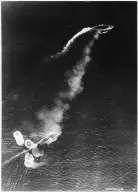
Phillips and Force Z — sail without air cover?
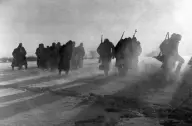
Snow Before Moscow — Zhukov and the Counter-Offensive
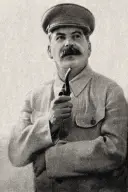
How far to press the advantage?
Bombers Toward Tokyo: A One-Way Mission
Arcadia — Germany or Japan First?
On the Eve of Pearl Harbor, a Decision in the Shadows
Secret staff talks in Washington
Curtin versus Churchill: the battle over the Pacific divisions
Strike America or hold the Atlantic?
Percival and Yamashita's Ultimatum
Phillips and Force Z — sail without air cover?
Snow Before Moscow — Zhukov and the Counter-Offensive
How far to press the advantage?
T10-036