Canadian Corvettes: Holding the Convoy
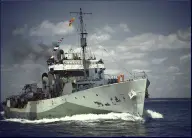
A escort corvette commander sails from St. John's, , to shepherd a merchant convoy along the route to Iceland. His navy, all but non-existent in 1939, has swelled in two years into a mass of small ships built in haste; he himself commands a Flower-class corvette, sturdy but tiny, that rolls horribly in the North Atlantic swell.
The weaknesses are well known aboard. Many Canadian corvettes have not yet received modern radar, their ASDIC is of an outdated type, and the crews, often made up of sailors trained in a matter of weeks, lack collective seasoning. The is then escorting the bulk of the slow SC-series convoys between and Iceland, the most exposed, while the losses inflicted by U-boat wolf packs grow worse over this winter of 1942. In the night, a lookout reports a contact: a submarine is prowling the edges of the convoy.
The commander must decide on the spot: stay massed around the freighters to provide a tight close defence; launch an immediate offensive ASDIC hunt toward the contact, at the risk of stripping the convoy; or, short of fuel and means, hold to a minimal escort and husband his reserves for the long crossing.
North Atlantic, February 1942, a Canadian corvette commander: how to protect an HX convoy with inadequate means?
Lacking escort groups that were numerous or well equipped enough, the Canadian corvettes most often held to the close defence of the convoy, their absolute priority. Starting from a handful of ships in 1939, the by 1942 was escorting a large share of the transatlantic convoys and finished the war as one of the largest escort forces in the world. The price was heavy: overworked, under-equipped corvettes, exhausted crews, and convoys under Canadian guard that suffered in 1942 a very high share of Allied tonnage losses in the Atlantic. Poorly furnished with radar and pushed to the back of the queue for modern equipment, these escorts paid in men and ships for an accelerated apprenticeship. Canada's role nonetheless became decisive in the Battle of the Atlantic, whose outcome governed the supply of the United Kingdom and the preparation of the landings.
Learn more about this event
Related polls
10
A Tanker Alone Off Cape Hatteras
Badung Strait: Striking the Bali Convoy
Decima MAS: Where to Strike After Alexandria?
Convoy HX 21 — Wake-Walker at Halifax
Ceylon Under Threat — Defending the Gate of the Indian Ocean
Strike America or hold the Atlantic?
Java Sea — Doorman and the ABDA Squadron
Course for Malta: Force the Passage or Turn Back
Battleships Stuck in Port for Want of Fuel — Central Mediterranean
Six Swordfish Against the Squadron — the Channel Dash
A Tanker Alone Off Cape Hatteras
Badung Strait: Striking the Bali Convoy
Decima MAS: Where to Strike After Alexandria?
Convoy HX 21 — Wake-Walker at Halifax
Ceylon Under Threat — Defending the Gate of the Indian Ocean
Strike America or hold the Atlantic?
Java Sea — Doorman and the ABDA Squadron
Course for Malta: Force the Passage or Turn Back
Battleships Stuck in Port for Want of Fuel — Central Mediterranean
Six Swordfish Against the Squadron — the Channel Dash
T10-111