
Westerplatte — Sucharski under the Schleswig-Holstein's guns
, 41, has commanded the Wojskowa Składnica Tranzytowa — the Polish military transit depot on the Westerplatte peninsula, inside the port of Danzig (a free city under the Treaty of Versailles) — since December 1938. His garrison numbers 182 regular soldiers, some 20 reservists and a handful of civilians: roughly 210 men in all.
The mission set by Warsaw is plain: hold for 12 hours in case of attack, long enough for the regular Polish forces to react. On 25 August 1939, the German training battleship Schleswig-Holstein entered Danzig on a "courtesy visit". The Polish gunners noted that the ship had moored 400 metres from the peninsula — optimum range for its 280 mm guns. Sucharski quietly reinforced his positions, laid wire, topped up rations and ammunition.
On 1 September 1939 at 04:47, the Schleswig-Holstein opens fire. A company of German marine infantry attacks overland. By the morning of 2 September, Westerplatte still holds. On the morning of 7 September, after 6 and a half days of bombardment, the garrison has lost some 15 men and has only a few hours of ammunition left.
Westerplatte, 7 September 1939, you are Major Sucharski: the 12-hour mission has lasted 7 days — should you stop the fight?
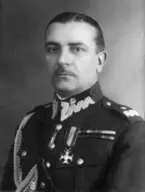
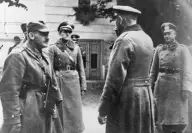
Sucharski surrenders to spare his men on the morning of 7 September, the 12-hour mission having been exceeded by more than 5 days. He raises the white flag at 10:15. The garrison marches out in good order, Sucharski in uniform with his sabre — which the German officer returns to him in tribute. Official Polish losses: 15 dead. The German figures are disputed: between 50 dead (official) and 300-400 (later Polish estimates, probably exaggerated). The garrison goes into captivity; Sucharski is interned in an oflag until 1945. He dies at Naples in August 1946 without ever seeing Poland again. His body is brought back to Westerplatte in 1971. The defence becomes one of the founding myths of Polish resistance. A historiographical controversy persists over Sucharski's actual role: according to certain testimonies (Dąbrowski, Grodecki), he was in a state of shock from 2 September onward, with effective command passing to Captain .
Learn more about this event
Related polls
10
Brześć — Plisowski faces Guderian
Modlin — Thommée at the last fortress
Mokra — Filipowicz and the Volhynian Brigade
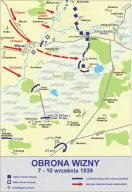
Wizna — Raginis in the Górka bunker
Kock — Kleeberg on the morning of 6 October
Wytyczno — Orlik-Rückemann after Szack
The Bzura — Kutrzeba faces the trap
Hel — Unrug faces the German envoy
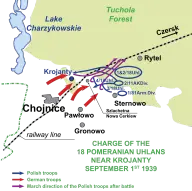
Krojanty — Mastalerz and the 18th Uhlans
Lwów — Langner between 2 occupiers
Brześć — Plisowski faces Guderian
Modlin — Thommée at the last fortress
Mokra — Filipowicz and the Volhynian Brigade
Wizna — Raginis in the Górka bunker
Kock — Kleeberg on the morning of 6 October
Wytyczno — Orlik-Rückemann after Szack
The Bzura — Kutrzeba faces the trap
Hel — Unrug faces the German envoy
Krojanty — Mastalerz and the 18th Uhlans
Lwów — Langner between 2 occupiers
T01-001