
Singapore, 1942: The Army of Prisoners
Captain finds himself among the 45,000 Indian soldiers captured in the fall of on 15 February 1942, the largest surrender in British military history. In the days that follow, Japanese officers put a remarkable proposition to him: raise, among these demoralised men whose legal status is uncertain, an army that would fight alongside Japan to drive the British out of the Indian subcontinent.
The dilemma cuts in several directions at once. has sworn an oath to the British Crown, and breaking that oath could expose his men to being treated not as prisoners of war but as traitors. Yet tens of thousands of Indian soldiers are at the mercy of Japanese guards whose treatment of prisoners elsewhere has proved brutal. At the same time, the movement for Indian independence has galvanised public opinion for decades, and some Indian officers see in Britain's defeat a historic opportunity.
must weigh 3 irreconcilable imperatives: forming a volunteer to fight British colonial rule alongside Japan, at the risk of becoming an instrument of Japanese imperial policy; refusing the offer and remaining a prisoner of war loyal to his oath, trusting the Geneva Conventions to protect his men; or limiting his role to the protection of Indian prisoners without committing troops to combat, seeking a position between resistance and collaboration.
Singapore, 17 February 1942, Indian officer taken prisoner after the fall of the fortress: should Mohan Singh respond to the Japanese offer?
accepts and by the summer of 1942 raises an numbering roughly 40,000 men. Tensions with the Japanese command, which intends to use the INA as a docile instrument, quickly become intolerable: in December 1942 dissolves the army and is arrested. The INA is reborn in 1943 under and fights in Burma until 1945. The trial of its officers in Delhi in 1945-1946 triggers a wave of outrage that erodes the legitimacy of the British Raj. A deeply ambiguous episode between collaboration and anticolonial struggle, it still weighs on India's memory of independence.
Learn more about this event
Related polls
10
Bruneval: The Secret of the Würzburg
Curtin versus Churchill: the battle over the Pacific divisions
Demyansk: hold the pocket or break out?
Java Sea — Doorman and the ABDA Squadron
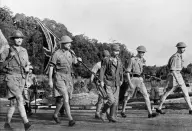
Percival and Yamashita's Ultimatum
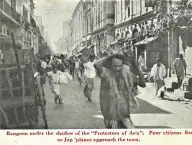
Rangoon on the Brink
Six Swordfish Against the Squadron — the Channel Dash
The Last Stand of Perth and Houston

The Lost Company of Timor
Will the RAF change its target?
Bruneval: The Secret of the Würzburg
Curtin versus Churchill: the battle over the Pacific divisions
Demyansk: hold the pocket or break out?
Java Sea — Doorman and the ABDA Squadron
Percival and Yamashita's Ultimatum
Rangoon on the Brink
Six Swordfish Against the Squadron — the Channel Dash
The Last Stand of Perth and Houston
The Lost Company of Timor
Will the RAF change its target?
T10-055