
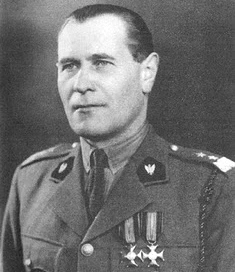
Bohusz-Szyszko at Coëtquidan
In the spring of 1939 the Polish (Strzelcy Podhalańscy) had been operating in the Carpathians. Wiped out in September 1939, many of its officers and men had reached France by way of Hungary. On 9 January 1940 Sikorski and the Polish government in exile decided to raise the () — an alpine rifle formation intended to fight alongside the French in the Allied expeditionary corps for Finland.
By the time the brigade was forming, the Finnish expedition had in fact been cancelled by the Peace of Moscow (12 March 1940). The brigade was then redirected to Norway (the Narvik campaign, April-May 1940).
, 46, commanded the brigade. Strength on 28 February 1940: 4,700 men in eight rifle battalions, with French equipment (modified Lebel rifles, MG34s captured in November 1939, 81 mm Brandt mortars, FM 24/29). Training was compressed into six weeks: mountain marching, skiing, cold-weather combat. Many had come from the Carpathian rifle units of 1939 and were already trained.
Bohusz-Szyszko had to decide the brigade's organisational stance within the Allied order of battle.
What organisational posture should be chosen for the Podhalańska Brigade?
Sikorski and Bohusz-Szyszko opted for C. The brigade fought at Narvik from April to June 1940 under French command (General ) but with tactical autonomy. The fighting on the heights of Beisfjord and Ankenes in May 1940 produced the advance on and capture of Narvik on 28 May 1940. Polish losses: 97 killed, 189 wounded. Evacuated to Brest in mid-June when France collapsed. The brigade was partly absorbed into the Polish Army in Britain, partly interned in Switzerland. Bohusz-Szyszko went on with the in Syria, Palestine and at Tobruk in 1941, then commanded the in Italy (Monte Cassino, 1944) under Anders. He refused to return to communist Poland. He emigrated to London. Died in 1982. The Podhalańska Brigade remained one of the first major Polish combat units reconstituted in exile — a model for Anders' army.
Learn more about this event
Related polls
10
Béthouart at Briançon — preparing Narvik
The British Soldier Sent to France with the BEF
Lwów — Langner between two occupiers
Baku in the crosshairs — Operation Pike
Bjelovar: desert the Yugoslav army or hold the line
The Supreme Allied Council faces Finland
Should Finland be helped?
The war of the airwaves
The Latvian police battalions under German command
Poles and Czechs in France
Béthouart at Briançon — preparing Narvik
The British Soldier Sent to France with the BEF
Lwów — Langner between two occupiers
Baku in the crosshairs — Operation Pike
Bjelovar: desert the Yugoslav army or hold the line
The Supreme Allied Council faces Finland
Should Finland be helped?
The war of the airwaves
The Latvian police battalions under German command