
Convoy HX 21 — Wake-Walker at Halifax
The transatlantic convoy system was established on 6 September 1939 — three days after the declaration of war. The doctrine: all merchant ships crossing the Atlantic were to sail in grouped convoys under escort by the Royal Navy or the Royal Canadian Navy. HX (Halifax to UK) for heavy convoys (freighters), OB (UK to Halifax) for empty returns.
Convoy HX 21 left Halifax (Nova Scotia, Canada) on 15 December 1939. Composition: 28 loaded merchant ships (Canadian wheat, Argentine beef via Buenos Aires-Halifax, Bolivian ores, American industrial equipment). Total tonnage: 140,000 tons of cargo. Initial escort: 4 Canadian destroyers (HMCS Saguenay, Skeena, Restigouche, Fraser) for the first 800 miles. Relief: British escort (4 destroyers) for the remaining 1,200 miles to Liverpool.
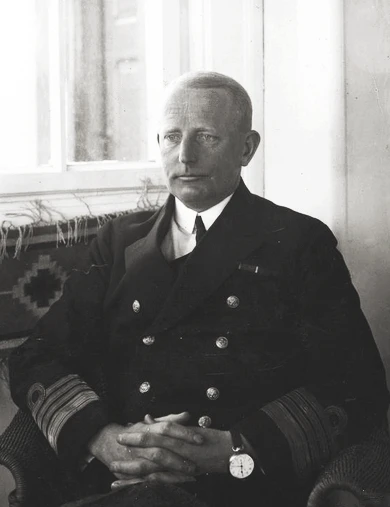
Commodore , 51, was an experienced convoy commander — a Royal Navy veteran since 1903. His flagship: the cargo Empress of Britain (42,000-ton capacity). Mission: cross without losses in 14 days, avoiding the U-boats lurking in the Western Approaches.
Wake-Walker had to choose his doctrine in the event of U-boat detection.
How should Wake-Walker manoeuvre if a U-boat is detected?
Wake-Walker applied B. Convoy HX 21 crossed the Atlantic in a formation of 8 columns of 3 to 4 ships, spaced 400 yards within columns and 1,000 yards between columns. Speed: 8 knots. On 22 December, a U-boat (probably 's U-37) was picked up on the Asdic sonar of HMCS Saguenay in the Western Approaches. The convoy held formation, the destroyers dropped depth charges, the U-boat dived deep and lost contact. No ship was lost. HX 21 arrived at Liverpool on 29 December 1939: 28 out of 28 ships intact, 140,000 tons unloaded without damage. It was one of the first major successes of the British convoy system. Wake-Walker went on to command transatlantic convoys until May 1941, then took command of the force intercepting the Bismarck (May 1941, in direct contact during the sinking of HMS Hood on 24 May). Promoted vice-admiral in 1942. Died in 1945, aged 57. The HX-OB convoy system remained in place throughout the war — 364 HX convoys in total, carrying 18,000 ships.
Learn more about this event
Related polls
10

Borakowski and the merchant fleet
Harwood against the Graf Spee
Langsdorff at Montevideo — 17 December
Vinson and the Two-Ocean Navy Act
Goering — the economic mobilization plan
HMS Rawalpindi — Kennedy at 3:47 p.m.
HMS Sphinx at Kinnaird Head
Carol II in Bucharest — the Romanian balance
Dunkirk — Tennant and the devastated port
Hel — Unrug faces the German envoy
Borakowski and the merchant fleet
Harwood against the Graf Spee
Langsdorff at Montevideo — 17 December
Vinson and the Two-Ocean Navy Act
Goering — the economic mobilization plan
HMS Rawalpindi — Kennedy at 3:47 p.m.
HMS Sphinx at Kinnaird Head
Carol II in Bucharest — the Romanian balance
Dunkirk — Tennant and the devastated port