
The fort of Battice isolated
After the withdrawal of the field army towards the KW Line, the forts of the Fortified Position of Liège were left behind, isolated behind the German lines. The fort of Battice, one of the most powerful, found itself encircled, its garrison cut off from the command, with no hope of relief or rescue.
For this garrison, the question was that of all besieged works. To continue resisting pinned down German forces, hampered their communications and saved the garrison's honour, but condemned the men to a siege with no way out, under bombardment and assault. To surrender spared lives, but freed the enemy of a thorn in its side.
The garrison could resist to the end, as long as food and ammunition held out, to pin down the enemy. It could surrender once the situation was judged hopeless and the field army out of reach. Or it could attempt a sortie to rejoin friendly lines — well-nigh impossible. Like the other forts of Liège and Namur, Battice embodied the dilemma of fixed fortifications in a war of movement.
Should the garrison of Battice resist to the end, surrender, or attempt a sortie?
The garrison chose A: the fort of Battice resisted, isolated, under German bombardment and assault, until 22 May 1940, long after the withdrawal of the field army. Like the forts of Aubin-Neufchâteau or Tancrémont, it pinned down enemy forces and put up a prolonged resistance, without being able to alter the course of the campaign. Surrender came only when its means were exhausted and all military usefulness had vanished. Battice illustrates, on the scale of a single work, the fate of the Belgian forts of 1940: a courageous, solitary resistance, heir to that of 1914, but outpaced by a war in which the decision was reached in movement, far from the buried concrete.
Learn more about this event
Related polls
10
The abatis of the Chasseurs Ardennais
The Battle of the Lys
Bodange — Bricart and the Chasseurs Ardennais
The Last Stand on the Lys
The bridges of the Meuse
Eben-Emael — Jottrand under the explosions
The fort of Aubin-Neufchâteau
The garrison of Ében-Émael
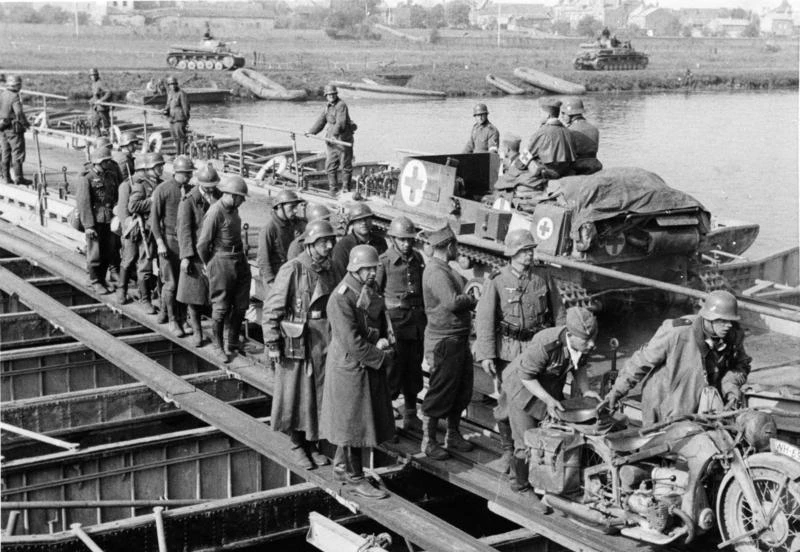
The charges are set beneath the deck
Kanne bridge — fourth airborne target
The abatis of the Chasseurs Ardennais
The Battle of the Lys
Bodange — Bricart and the Chasseurs Ardennais
The Last Stand on the Lys
The bridges of the Meuse
Eben-Emael — Jottrand under the explosions
The fort of Aubin-Neufchâteau
The garrison of Ében-Émael
The charges are set beneath the deck