
Wavell Against the 150,000 Italians — Egypt, September 1940
General , British Commander-in-Chief Middle East from Cairo, administers an immense theatre stretching from the Sudan to Palestine. An officer noted for his composure and his learning, he commands a handful of divisions where Mussolini's Italy fields hundreds of thousands of men in Libya and East Africa.
His , under General , numbers about 36,000 men, 275 tanks and 120 guns, deployed around Mersa Matruh. For weeks, convoys have been bringing him up to 1,000 men a day, along with matériel and vehicles to reinforce his limited numbers.
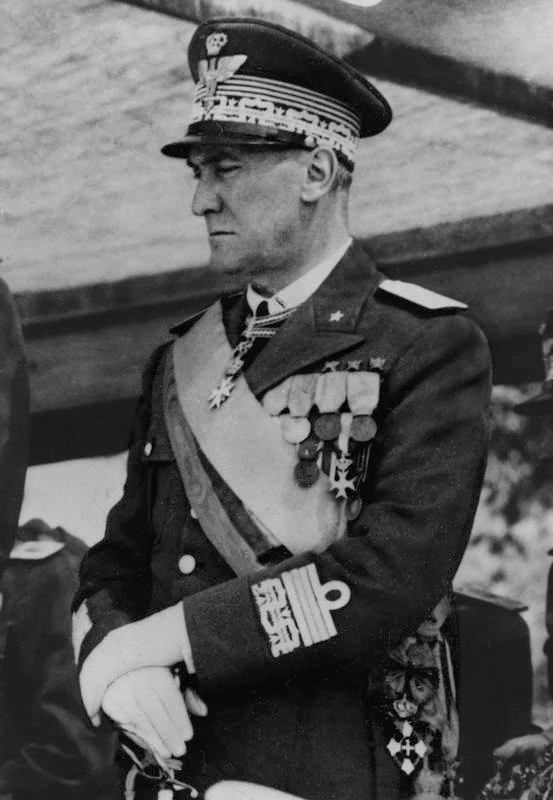
On 13 September 1940, Marshal launches the — some 150,000 men, 1,600 guns — across the frontier. In three days, the Italians advance some sixty miles and halt on 16 September at Sidi Barrani, where they dig in within a series of fortified camps to await supplies and reinforcements.
Wavell is massively outnumbered. The chiefs of staff reckon, however, that the Italians are short of fuel and food. On 11 September, Wavell gathers his subordinates to settle the course of action against an enemy vast in number but at the end of his logistics.
While Graziani digs in at Sidi Barrani, what does Wavell decide for his desert theatre?
Wavell chose B. As early as September, he ordered the commander of British Troops Egypt, General , to plan a limited operation to push the Italians back — what would become Operation Compass. On 28 November, he wrote to Wilson that he "entertained no extravagant hopes" but wanted to be ready "to exploit to the full" a great opportunity should one arise. Conceived as a five-day raid, the offensive was launched on the night of 7-8 December, with the main attack opening on 9 December 1940. The success surpassed anything Wavell had imagined: in two months, the , tiny as it was, crushed the 10th Army, took tens of thousands of prisoners and advanced as far as Beda Fomm. Compass became the first great British land victory of the war.
Learn more about this event
Related polls
10
Peng Dehuai — the Hundred Regiments Offensive
Peng Dehuai — leaving guerrilla war behind?
Platt before Kassala — January 1941
Crusader: The Generals' Doubt
"Cromwell" — England, 7 September 1940
Cunningham toward Mogadishu
Graziani enters Egypt — Sidi Barrani
Graziani inherits the Libyan desert
Arras — the Matildas against Rommel's flank
De Gaulle at Abbeville
Peng Dehuai — the Hundred Regiments Offensive
Peng Dehuai — leaving guerrilla war behind?
Platt before Kassala — January 1941
Crusader: The Generals' Doubt
"Cromwell" — England, 7 September 1940
Cunningham toward Mogadishu
Graziani enters Egypt — Sidi Barrani
Graziani inherits the Libyan desert
Arras — the Matildas against Rommel's flank